Where is all the Hypertext Fiction in this Digital Age?
Last term (Fall
2013) I wrote a paper titled “Where is all the Hypertext Fiction in this
Digital Age?” because looking at the potential of current multimedia
technologies and the increased market for e-books, I wondered why is hypertext
fiction not dominating at the bestseller lists?
Our reading this
week by Jill Walker Rettberg gives a nice overview of the history of electronic
literature. She outlines five categories of e-literature and my paper was inspired by the “canon”, which is hypertext fiction repeatedly taught and cited in
colleges and universities.
Through my
research for the paper, I found several reasons why hypertext is not more
prominent in e-books today including: technical design issues, copyright laws,
digital rights management, and issues with ‘stocking’ e-books. But there are also
more foundational issues, which are:
·
the
phenomenological experience of reading print books,
·
remediating
the book metaphor & the web space, and
·
issues
with narrative form (e.g. plot).
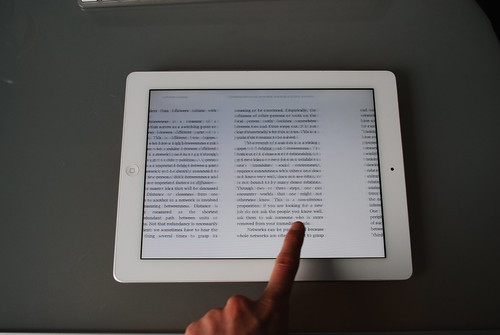
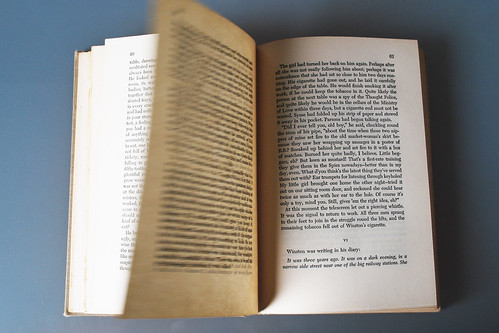
People often
state that they prefer to read print books because of the feel and smell of the
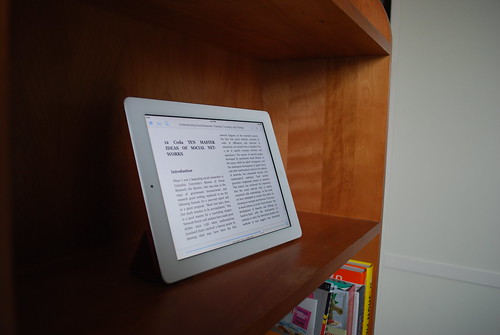
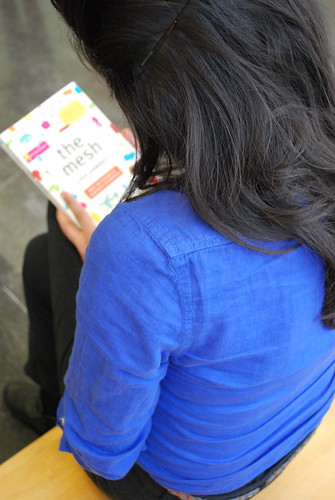
book – the phenomenological experience. Publishers have mastered the print
format. The act of clicking when reading hypertext impacts the phenomenological
immersion in narrative fiction and it results in impatience often experienced
when surfing the Internet (Mangen, 2008). We have yet to discover the best way
to give readers an equally pleasant phenomenological experience with e-books.
Historically, the
word “book” meant the collection of papyrus and so how can we define an e-book
when there is no paper?
Hypertext books
are “an attempt to overcome the limitations of paper books by adding a series
of useful features made possible through the nature of the electronic
environment” (Crestani, Landoni, & Melucci, 2005, p. 193). The book
metaphor has been used for e-book creation because it is already familiar to
writers, readers and publishers. The book metaphor includes having a linear
structure, page numbers, margins, covers, and other qualities of this
universally recognized format.
Hypertext writers
went beyond the book metaphor by introducing chunk-style or puzzle-like
stories. Wardrip-Fruin (2004) says that the definition of hypertext has become
synonymous with “chunk-style media” because most authors of hypertext fiction
and poetry used link-based formats. Thus, there is a need to distinguish the
hypertext not only from the book metaphor, but also from the conventions of the
World Wide Web.
The hypertext
book with its deviating linear structure can cause the reader to get lost and
decrease their investment in the story. It can leave the reader feeling
fatigued and unsatisfied at the end (Landow, 1992). Non-linear hypertext
writing was also a challenge for authors. Coover notes that, “the author has a
fear of loosing control of the story because it becomes an obligation to write
so many different directions of the story” (as cited in Landow, 1992, p. 119).
One of the
well-cited examples of a hypertext narrative is Patchwork Girl by Shelly
Jackson published in 1995 by Eastgate Systems using Storyspace software. The
narrative offers two paths that the reader can move back and forth between,
“until finally the narrative settles into a long sequence of lexias, each with
only one possible link” (Hackman, 2011, p. 94). Hackman (2011) argues that even
as a hypertext book, the story relies on print conventions: “characteristics of
wholeness and permanence associated with paper and print, and the materiality
of paper as a metaphor for the patchworked body of the creature” (p. 102).
Therefore, one of the first-generation examples of hyperfiction does not go too
far beyond familiar linear narrative convention of the print book.
The new medium
calls for new literary forms. In this case, would the hypertext book become
more successful if new narrative conventions were established for the digital
medium?
Concluding thoughts
Landow (1992)
determined that hypertextual narrative’s defining qualities are: “its non- or
multilinearity, its multi-vocality, and its inevitable blending of media and
modes, particularly its tendency to marry the visual and the verbal” (p. 103).
So far, instead of concentrating on the multimedia aspects, most authors have concentrated
on the effects the hypertext format will have on the linear narrative (Landow,
1992).
The hypertext
book has not yet been able to embrace the new digital media in a way that offers
added value for readers. Writers, publishers and e-books designers need to look
beyond the non-linear and hyperlinking aspects to find the best ways to create
a narrative and design a hypertext that results in a positive phenomenological
experience for readers.
Please be kind in the comments, this was an exploratory paper.
Crestani, F., Landoni, M., & Melucci, M. (2005). Appearance and functionality of electronic
books: Lessons from the Visual Book and Hyper-TextBook projects. International
Journal on Digital Libraries, 6(2), 192-209.
Hackman, P. (2011). “I am a Double Agent”: Shelly Jackson’s Patchwork Girl and the persistence of print in the age of hypertext. Contemporary Literature, 52(1), 84-107.
Landow, G. P. (1992). Hypertext: The Convergence of Contemporary Critical Theory and Technology. Maryland: The Johns Hopkins University Press.
Mangen. A. (2008). Hypertext Fiction Reading: Haptics and immersion. Journal of Research in Readings, 31(4), 404-419.