Showing posts with label Assignment 3. Show all posts

Friday, 4 April 2014

Assignment #3: The Interaction Between Digital Network Media, Publishing, & Society


By Jonathan Krywulak

 
The emergence of digital network media has transformed the 21st century society and its relationship with publishing institutions.   The expression and perception of social identities has been shaped by new forms of technology that spans cultural spheres and geographical boundaries allowing communication from many to many.  The increased speed, convenience and interactivity of new media have blurred the distinction between consumers and producers, providing people with the ability to be in control of their own media world.


References:

Benkler, Y. (2006). The wealth of networks: How social production transforms markets and
freedom. Yale University Press.
 
Tubella, I. (2004). Television and internet in the construction of identity. The Network Society: A
Cross-Cultural Perspective. Cheltenham, UK & Northampton, MA: Edgard Elgar
Publishing Limited
 
Audio Clip #1:  Windows sounds mix by DJ Titon. Retrieved from http://youtu.be/cewQJFTolO0

Audio Clip #2:  Shirky, C. (2009) How social media can make history. Retrieved from https://www.ted.com/talks/clay_shirky_how_cellphones_twitter_facebook_can_make_history

Audio Clip #3: Lessig, L. Crash course in the "read-write" internet. Retrieved from http://www.youtube.com/watch?v=7nBL8eClYuU

Audio Clip #4: Lessig, L. Creativity.  Retrieved from http://www.youtube.com/watch?v=NGWQVxrRXyU

Assignment #3: Old and New Media Power Struggle


We explore, through 2 interviews with Dr Henry Jenkins, how digital network media has shifted the power from traditional publishing institutions to society. News is no longer delivered only by newspapers. Rather, because of the internet, we are in a convergence culture where new media users participate and collaborate in creating news, or spreadable media, that moves from grass roots communication through out society.


Burnett, L. (2013, March 10). #SXLB: Henry Jenkins, Media Theorist, Author & Professor, Pt. 1: Grassroots. Retrieved April 3, 2014, from You Tube.

Dixon, A. (2012, 21). A Word From Henry Jenkins on Convergence. (Students Demonstrating Example of User Generated content) Retrieved April 3, 2014, from You Tube.

Edmonds, R.G. (2013, May 7). Newspapers: by the Numbers. Retrieved April 3, 2014, from The Pew Research Center's Project for Excellence in Journalism: 

Laird, S. (2012, April 18). How Social Media Is Taking Over the News Industry [INFOGRAPHIC]. Retrieved April 3, 2014, from Mashable 

Sondeen, A.L. (2009). Building Blocks for Change Increasing Newspaper Readership in the Age of Electronic Media throu Innovations in Style and Approach. Senior Honors Theses, Easter Michigan University, DigitalCommons@EMU. Retrieved April 3, 2014, from  http://commons.emich.edu/cgi/viewcontent.cgi?article=1192&context=honors

Wednesday, 2 April 2014

Assignment 3: The Remix Culture: A Case Study Analysis of Mash-Up through a Radio Documentary

By: Mandeep Jawanda

The question I examined for this assignment was, “Remix culture is fundamentally at odds with older media institution and practises.” This question was answered through a sound piece which I created and produced using the platform SoundCloud. Moreover, in order to provide further clarity on the subject matter, I reviewed a case study by Michael Serazio (2008), “The Apolitical Irony of Generation Mash-Up: A Cultural Case Study in Popular Music.”
It was determined that remix can represent many different terms; therefore for this documentary I only looked at the mash-up, and its impact on the music industry. In particular, how the music industry personnel reacted to the infringement of their artist’s music. Furthermore, how mash-ups impacted society, and shaped our individual identities.

In the end through my analysis, it was determined that the mash-up is not something new, but has been present for a long time within our society. Technological innovations in the form of information technologies (IT) have made people more cognisant of these types of work. 

Click on this link to go to my Sound Piece located at SoundCloud.com

Serazio, M. (2008). The Apolitical Irony of Generation Mash-Up: A Cultural Case Study in Popular Music. Popular Music & Society, 31(1), 79-94. doi:10.1080/03007760701214815
First Audio Clip: We Love MashUp Feb 2013
Posted by user: PonTiR3c0rds
YouTube Link Retrieved from: http://www.youtube.com/watch?v=h2VH08RLB24
Second Audio Clip: Steve Carell: NO GOD! NO GOD, PLEASE NO, NO, NO, NOOOOO (HD)
Posted by user: lNicrolax v.2
YouTube Link Retrieved from: http://www.youtube.com/watch?v=H07zYvkNYL8
Background Audio Music:  Free Background Music 12: Dreams (120 bpm)
Posted by user: music by longzijun
YouTube Link Retrieved from: http://www.youtube.com/watch?v=QRtHl9n-G3o

Tuesday, 1 April 2014

Assignment 3 - An Outlook for Artistic Culture: Some Reflections in a Digital Age

By Nicole Basaraba

Art in the Machine Age

"In the days before machinery, men and women who wanted to amuse themselves were compelled, in their humble way, to be artists. Now they sit still and permit professionals to entertain them by the air of machinery. It is difficult to believe that general artistic culture can flourish in this atmosphere of passivity" (Huxley, 1927).

Aldous Huxley is stating that the “Machine Age” was causing a lack of creativity in American culture because people passively consumed what was produced by professionals.

http://www.biography.com/people/aldous-huxley-9348198
Aldous Huxley via www.biography.com
Walter Benjamin, a 19th century German theorist and literary critic, wrote a paper called “The Work of Art in the Age of Mechanical Reproduction”, which addresses the topic of artistic culture in the Machine Age. Benjamin (1936) wrote, “for the first time in world history, mechanical reproduction emancipates the work of art from its parasitical dependence on ritual” (Benjamin, p. 224). He argued that mechanical reproduction eliminated the authenticity (or aura) of art, photography, and film. In other words from a rhetorical theory perspective, a work of art lost some of its ethos, its specific character or its originality because there were several copies.

Benjamin (1936) described film as “the promotion of a revolutionary criticism of traditional concepts of art” (p. 231). Due to the lack of aura (or cult value), audiences became critics of film instead of consuming them in awe. The masses could experience a work of art in many different contexts and it gave them the opportunity to think critically rather than being passive.

Although, the Machine Age encouraged critical evaluation, it did not allow viewers to participate in the creation. This aspect may account for Huxley’s argument that creativity and artist culture diminished during the Machine Age because art creation was managed by the “gatekeepers” namely museums and galleries curating artwork, film directors, music producers, and traditional publishing houses. The artists became part of an elite group, who were selected by ‘gatekeeping’ experts. The resulting pool of artists was small and definitive.

The ‘Digital Age’ shows that Huxley’s statement is outdated because the Internet has spawned an explosion of creativity in traditional and new formats.

Art in the Digital Age – Online publishing

Tim Berners-Lee invented the World Wide Web in 1989 and since then it has created a "global village" and given way to a new wave of artists. The Internet democratized art.

Clay Shirky refers to this democratization as “mass amateurization”. Shirky (2008) writes, “the future presented by the internet is the mass amateurization of publishing and a switch from ‘Why publish this?’ to ‘Why not?’” (p. 60). He points out that the definition of journalists in the Oxford Dictionary makes reference to the ‘gatekeepers’ and says, “journalists aren’t journalists unless they work for publishers, and publishers aren’t publishers unless they own the means of production,” (Shirky, 2008, p. 71). Writers, photographers, filmmakers, and other artists are no longer bound to publishers and their means of production, so it decreases the reliance on professionals.

Blogging and Citizen Journalism – Who are the professionals?

Blogs took off in 1999 when Blogger and Livejournal were created. The ‘blogosphere’ now has several other platforms like Wordpress, and Tumblr, which millions of people use to write, read, and share (wikipedia.org/blog). Blogs can be personal, but they can also be professional as many mainstream news organizations such as Huffington Post using them. Statistics showed that over 173 million blogs were on the Internet in 2011 (statista.com). So where is the line between blogging and journalism?

There is a categorization called citizen journalism. Mark Glaser (2006) explains, “the idea behind citizen journalism is that people without professional journalism training can use the tools of modern technology and the global distribution of the Internet to create, augment or fact-check media on their own or in collaboration with others.” Many bloggers write on the same topics covered by established media sources and often include the personal opinion of the writer(s). Blogging also gives the writers the ability to comment or report on issues not covered by the media.

Image via www.indymedia.org
Glaser (2006) notes, “there is some controversy over the term citizen journalism, because many professional journalists believe that only a trained journalist can understand the rigors and ethics involved in reporting the news.” Although, a prime example of successful citizen journalism is Indymedia.org. The Independent Media Center, originally created in 1999 to provide grassroots coverage of the World Trade Organization protests in Seattle, is now a place where journalists can gather information, reports, photos, audio and video footage. Since it operates on a democratic open-publishing model, hundreds of media activists have set up Indymedia websites in several countries (indymedia.org).

Shirky (2008) asks: who is a journalist, who is a photographer, who is a publisher? In the Digital Age, the answer is anyone; anyone who has the digital literacies to operate and access the Internet and the associated tools (e.g. computers, software, etc.). Bloggers can be journalists, journalists can be bloggers, and citizens can be photographers and publishers. Contradicting Huxley’s statement, blogging and citizen journalism are two examples of people being active rather than passive consumers.

Peer Production Networks – Are artists still humble?

Not only have citizens passed the gatekeepers, the Internet allows users to produce on a grand scale. People are no longer confined to their immediate environment or basic tools. In the “global village” they can work together to create massive online projects. Yochai Benkler, Professor at Harvard Law School, defines 'commons-based peer production' as “a form of open creation and sharing performed by groups online that sets and executes goals in a decentratlized manner” (2012, p. 1). The term makes reference to the democratization or amateurization of art. People participating in peer production networks create new works from online encyclopedias to folksonomies.

Image via wikipedia.org
Benkler applies this term to online projects. Wikipedia launched on January 15, 2001 is a collaboratively edited, multilingual, free Internet encyclopedia with 30+ million articles (wikipedia.com/wikipedia). It is one of the most successful and most referenced piece of collaboratively produced online work. Another example is LibraryThing, which results in the creation of folksonomy. With LibraryThing users participate in social tagging and as a result, they create new categories and terms to aid in searching for books. Tim Spalding (creator of LibraryThing) uses the example of new book genres being recognized in LibraryThing, such as Cyberpunk, which is not recognized by traditional taxonomic libraries like the Library of Congress (youtube.com). People participating in peer production are not humble any more because their collective action can have large-scale results on culture.

Creative Commons Licenses – Facilitating the remix

Creative Commons licenses, founded by Lawrence Lessig, Hal Abelson and Eric Eldred with the support of the Center for the public Domain, give the public permission to share and use creative work with conditions chosen by the creator. These licenses encourage creatively, participation, and collaboration. Lessig (2008) explains, ‘they (or at least the “young people of the day”) add to the culture they read by creating and re-creating the culture around them” (p. 28). There is a huge quantity of art on the Internet in multiple formats. Lessig (2008) explains, “they remix, or quote, a wide range of “texts” to produce something new” (p. 68). People are participating and creating art independently and collaboratively.  

YouTube is a video-sharing website that allows users to upload and share video blogs (vlogs), short original videos, music videos, and remixes. Lessig (2008) says, “remixed media may quote sounds over images, or video over text, or text over sounds. The quotes thus get mixed together. The mix produces the new creative work—the “remix”" (p. 68). YouTube is one of the most popular online mediums for remixing. Even large media corporations use it to connect with the platform’s millions of viewers and independent vloggers have become millionaires. The Creative Commons licensing options lets users encourage others to use their work, build on it, and remix it to create new art. This art form is starting to gain more formal recognition through the YouTube Music Awards for example.


Produsage – Not passivity

Axel Bruns, Associate Professor at Queensland University of Technology (Australia), coined the term ‘produsage’ to describe the new and fluid nature of digital artistic culture. Bruns (2008) explains that the old language fails us because we have used terms such as 'production', 'consumer', 'product' and 'audience' for so long (tracing back to the industrial age) that they have become well-defined. Bruns (2008) writes, “the emerging user-led environments of today can no longer be described clearly and usefully through the old language only – and produsage is my suggestion for an alternative term” (henryjenkens.org). Bruns clearly identifies the issue with Huxley’s statement, it is now a matter of history. In the ‘Digital Age’ we are produsers, not passive. We evaluate, critique and create. Bruns (2008) defines produsage as “the collaborative and continuous building and extending of existing content in pursuit of further improvement” (henryjenkens.org). Although, he notes that it is only the starting point. We are not only improving but, as the examples of new media show, we are creating new art.

Digital-born narratives - Creativity flourishing

Image via www.last.fm
Since Internet technologies have allowed the masses to self-publish blogs, videos, and other media such as podcasts and digital photography collections, it has resulted in new art. When moving into new mediums, we tend to remediate traditional modes of creation first. Now digital-born narratives are growing and show how far artistic culture has come. An example of digital-born narratives is Inanimate Alice, a story written by Kate Pullinger that was created and published in the digital medium. It involves sounds, images, video, and text as well as active participation of the reader. Digital-born narratives show that artistic culture has in fact flourished into something new.

To transform Huxley’s words in conclusion: In the days of the Internet, people who want to amuse themselves are compelled to be artists in a public and sometimes large-scale way. Now they sit in front of their computers and make art to entertain themselves and others by the air of digital technology. It is easy to see that general artistic culture can flourish in this atmosphere of creativity.


References

About Indymedia. Retrieved from https://www.indymedia.org/or/static/about.shtml

Benjamin, W. The Work of Art in the Age of Mechanical Reproduction http://www.ejumpcut.org/archive/onlinessays/JC15folder/WalterBenjamin.html

Benkler, Y., Shaw, A. and Hill, B.M. (2012). Peer production: A modality of collective intelligence. Retrieved from http://mako.cc/academic/benkler_shaw_hill-peer_production_ci.pdf

Blog. Retrieved from http://en.wikipedia.org/wiki/Blogs


Glaser, M. (2006). Your guide to citizen journalism. Retrieved from http://www.pbs.org/mediashift/2006/09/your-guide-to-citizen-journalism270/


Huxley, A. (1927). The outlook for American culture: Some reflections in a Machine Age. Harper’s Magazine.

Pullinger, K., Joseph, C. and Campbell, A. (2012) Inanimate Alice. Retrieved from http://www.inanimatealice.com/about.html


Jenkins, H. (2008). From Production to Produsage: Interview with Alex Bruns. Retrieved from     http://henryjenkins.org/2008/05/interview_with_axel_bruns.html

Lessig, L. (2008). Remix: Making art and commerce thrive in the hybrid economy. Retrieved from https://archive.org/stream/LawrenceLessigRemix/Remix-o.txt


Number of blogs worldwide from 2006 to 2011 (in millions). [Graph]. Retrieved from http://www.statista.com/statistics/278527/number-of-blogs-worldwide/

Shirky, C. (2008). Here comes everybody: The power of organizing without organizations. New York: Penguin Group.

Spalding, T. (2009). What is Social Cataloguing 2/6. Retrieved from https://www.youtube.com/watch?v=Kt94e9mX320

Wikipedia. Retrieved from http://en.wikipedia.org/wiki/Wikipedia

YouTube. Retrieved from http://en.wikipedia.org/wiki/Youtube


Monday, 31 March 2014

Diana Brown's Assignment #3 - Paper vs. Pixels: Printed Books and eReaders in Education

When publishing changes, so does society. Investigate and compare the impact of two publication technologies, one pre-1900 and one post-1962, on a specific aspect of society (e.g. education, politics, creative industries, science, entertainment, social relationships). 

The publishing technologies that I chose to compare were printed books versus electronic books (available on various eReaders). Newton’s Third Law of Motion is relevant to this topic because “for every action there is an equal and opposite reaction”. It seems as though for every upside to traditional publishing and printed books, there is a downside to ePublishing and eBooks. It also works the other way around - for every eBook pro there is strike against printed books.

Although society often focuses on the shortcomings of each medium, we need to stop treating these two resources as opposing forces, as each serves unique purposes. These publishing platforms can work together and make up for each others deficiencies to provide timely, relevant and authentic information for use in educational settings.

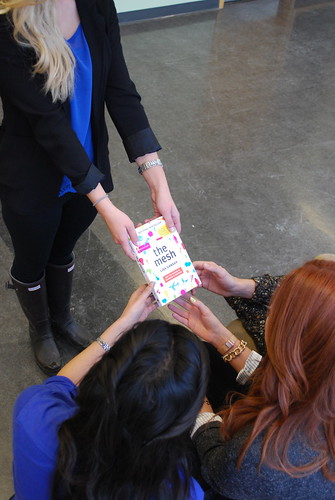
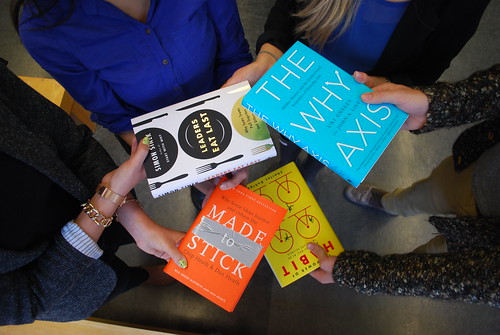
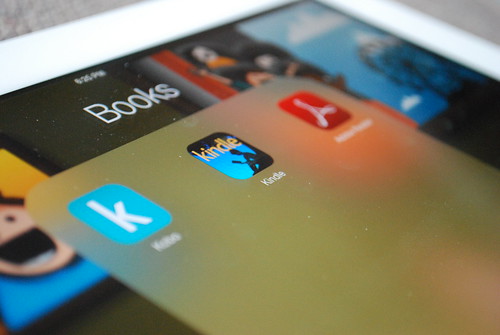
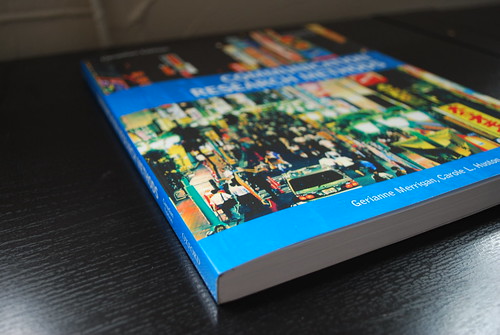
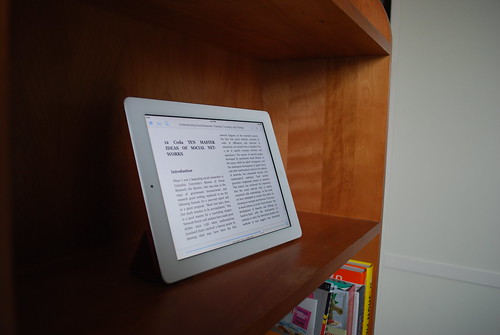
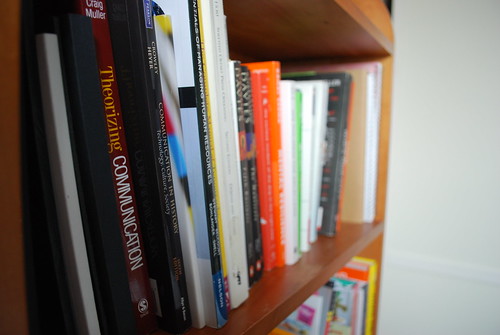
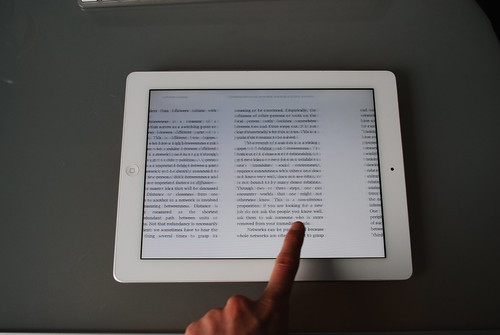
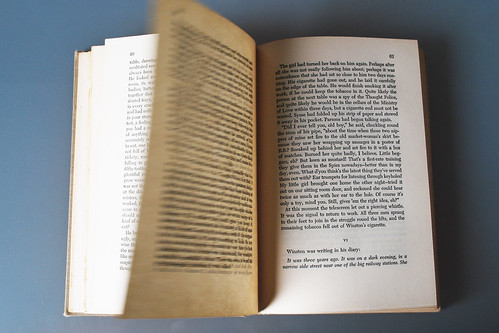
In my Flickr photo collection, I have juxtaposed printed books and eBooks to show how one’s weakness is the other’s strength. My goal in this collection is to show how each medium balances the other (… the yin and yang of publishing!). Here is how each format reigns supreme in various categories of importance to readers in educational settings:


Book
eBook
Authenticity
✯


Longevity
✯


Readability
✯


Simplicity
✯


Reliance
✯


Searchability


✯
Portability


✯
User Experience


✯
Accessibility


✯
Currency


✯

Please click here to see my set of 20 images on Flickr that capture the reasons why these two publishing platforms work so well together in the realm of education.


AUTHENTICITY

Authenticity - Book (Pro)
Book (Pro) - The physical book wins out over eBooks when it comes to authenticity. Printed books are generally seen as more credible because of the traditional publishing process (one-to-many model). This process ensures that the written work is vetted by many individuals (including literary agents, editors and retailers, among others). This helps “weed out’” inaccurate and low-quality work for use in educational settings.

Authenticity - eBook (Con)
eBook (Con) - eBooks can’t compare to physical books when it comes to authenticity. eBooks are simple to create and the process is becoming more streamlined all the time. Because of the ease of creation, anyone with a computer and an Internet connection can publish an eBook (many-to-many publishing model). When everyone is a publisher, who is responsible for filtering out the noise? Teachers? Students? This is still a grey area.


LONGEVITY

Longevity - Book (Pro)
Book (Pro) - The physical book wins out over eBooks when it comes to longevity. Printed works can last hundreds of years if properly preserved and even many decades if improperly preserved. Printed books can be used in the classroom and they will continue to exist in their physical form, with the exception that they are physically destroyed. You can spill a drink on them, remove parts and roll them up without doing damage to the overall product. When was the last time you said the same thing about an eReader?

Longevity - eBook (Con)
eBook (Con) - eBooks can’t compare to physical books when it comes to longevity. Sure, there is little fear that “ripping out pages” will damage a file, however one or two wrong clicks will result in a losing the entire work. The high cost of digital textbooks, paired with this sense of impermanence leaves consumers feeling uneasy about buying expensive ePublications. Additionally, purchasing eBooks are commonly thought of as “renting” not “buying” because files reside on server. This lack of control has some readers running for the hills!


READABILITY

Readability - Book (Pro)
Book (Pro) - The physical book wins out over eBooks when it comes to readability. Ink on paper provides high contrast and makes it easy to read the printed page. Off-white and cream-coloured stocks are typically preferred by long document publishers because they are easy on the eyes.

Readability - eBook (Con)
eBook (Con) - eBooks can’t compare to physical books when it comes to readability. Screen fatigue makes reading pixels on a screen tiring on the eyes. Many eReaders use e-ink technology to mimic ink on paper, but the simulation is never as good as the real thing.


SIMPLICITY

Simplicity - Book (Pro)
Book (Pro) - The physical book wins out over eBooks when it comes to simplicity. Books are intuitive to use and navigate - simply open up a book and begin reading. There are no wires or cords or electrical plugs to worry about. Ink on paper is as simple as it gets.

Simplicity - eBook (Con)
eBook (Con) - eBooks can’t compare to physical books when it comes to simplicity. File type confusion and incompatibility (.epub as the standard format vs. the .mobi Amazon Kindle-specific format) can make buying, downloading and reading a book challenging. The un-tech savvy reader may have difficulty understanding which format is needed for which device and it just isn’t the same as picking up a printed book.


RELIANCE

Reliance - Book (Pro)
Book (Pro) - The physical book wins out over eBooks when it comes to reliance. Books are stand-alone products that don’t need additional tools. Printed books do not rely on external power sources or high-tech gadgetry to be consumed. An eReader with low battery isn’t very useful during a power outage.

Reliance - eBook (Con)
eBook (Con) - eBooks can’t compare to physical books when it comes to reliance. eReaders require external power for recharging, as well as software support post-purchase. Because of this reliance on external power, eReaders are of little use in remote areas or situations where there is limited access to power (ex: studying for an exam on a transatlantic flight).

SEARCHABILITY

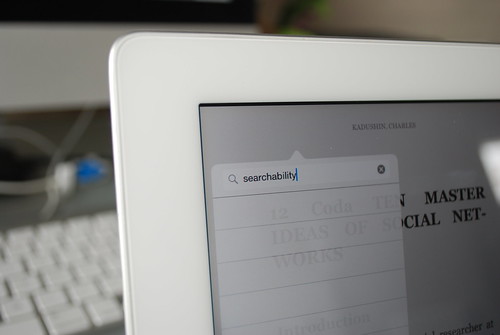
Searchability - eBook (Pro)
eBook (Pro) - eBooks win out over physical books when it comes to searchability. There is a search function within every eReading platform, which enables users to quickly and easily search for keywords throughout the document. Furthermore, hyperlinking increases the reach of standard search functionality by directing users to further information on the World Wide Web.

Searchability - Book (Con)
Book (Con) - Physical books can’t compare to eBooks when it comes to searchability. It takes time to find a specific passage or topic in a book, as the reader must look up keywords in the index or flip through book to find what they are looking for. The static nature of books makes them inherently difficult to search, which can be incredibly frustrating, especially for a student conducting research.


PORTABILITY

Portability - eBook (Pro)
eBook (Pro) - eBooks win out over physical books when it comes to portability. Students can carry a library’s worth of books on a very small device, which can be incredibly helpful for students who travel often. Whether commuting a short distance to school or travelling much further, eReaders are compact, lightweight and inherently portable.

Portability - Book (Con)
Book (Con) - Physical books can’t compare to eBooks when it comes to portability. It is logistically difficult to move multiple textbooks around. Paper is heavy and it is not easily transportable across campus or across the country. Multiple bags may be necessary to lug required books from one place to another (not to mention overweight baggage fees at the airport!).


USER EXPERIENCE

User Experience - eBook (Pro)
eBook (Pro) - eBooks win out over physical books when it comes to user experience. Online collaboration tools built into eReading devices connect one solitary reader to another directly on the reading platform. This facilitation of connecting like-minded readers with one another fosters a community of learners who don’t feel like they are tackling the material alone (even if they are at different schools in different cities or even different parts of the world). Furthermore, social networking capabilities within eReading platforms (ex: Kobo’s Reading Life) promote conversation and lifelong learning within an online community.


User Experience - Book (Con)
Book (Con) - Physical books can’t compare to eBooks when it comes to user experience. Reading a book is a solitary experience and only one person can read a single book (comfortably) at one time. Students may feel a sense of isolation in the material they are studying because it is near to impossible to interact with other users through the platform of a physical book.


ACCESSIBILITY

Accessibility - eBook (Pro)

eBook (Pro) - eBooks win out over physical books when it comes to accessibility. Readers can choose their preferred typeface, font size and colour contrast level to suit their accessibility needs. Furthermore, audiobooks and read-aloud capabilities are more commonly available within the newer .epub files.

Accessibility - Book (Con)
Book (Con) - Physical books can’t compare to eBooks when it comes to accessibility. Small type, as well as low contrast or faded text can make a book difficult to read for someone with even a minor visual impairment. Although large-print options do exist, they are seldom available for textbooks.


CURRENCY

Currency - eBook (Pro)

eBook (Pro) - eBooks win out over physical books when it comes to currency. The nature of ePublications makes it so that there is a much faster time to market, as publishers do not have to wait for the books to be manufactured and distributed (which can take weeks). Furthermore, the ability to update an .epub file is much simpler and therefore has a faster time to market than traditional ink on paper products.

Currency - Book (Con)
Book (Con) - Physical books can’t compare to eBooks when it comes to currency. Time to market is much slower in a traditional publishing process; therefore the reader is not always reading the most current information. Updated editions of printed books do become available, but they are typically updated every few years. This can be especially critical for hi-tech fields, where the rate of technological change makes buying a textbook impractical when the information may change in a few months.