Welcome #NMN students to the final week of our class.
We will be having our live chat Monday night 18:15 Mountain time (31st of March). Bring your questions about Assignment 3. You will have the week to complete the assignment.
You can find the assignment in our eclass moodle and via google docs.
Showing posts with label syllabus. Show all posts
Showing posts with label syllabus. Show all posts
Monday, 31 March 2014

Monday, 17 March 2014
Week 11: Co-Creation & Crowdsourcing
Week
11: Co-Creation or Crowdsourcing: Moving Beyond Multiple Choice
|
Required
and Recommended Readings
|
This week we’ll talk about crowdsourcing and some models that work
best. We’ll end with a discussion of how crowdsourcing has improved so that
the final products are more viable.
|
n Yannig Roth, (May 2012). “Crowdsourcing and Co-Creation are
Complementary,” Innovation Excellence. http://www.innovationexcellence.com/blog/2012/05/31/crowdsourcing-and-co-creation-are-complementary/
n Marjanovic, S., Fry, C., & Chataway, J. (2012). Crowdsourcing based
business models: In search of evidence for innovation 2.0. Science
& Public Policy (SPP), 39(3), 318-332.
doi:10.1093/scipol/scs009
n Zwass, V. (2010). Co-Creation: Toward a Taxonomy and an Integrated
Research Perspective. International Journal Of Electronic Commerce, 15(1),
11-48. doi:10.2753/JEC1086-4415150101
n Tom Foremski, “Cultivating a Smarter Crowd: Norwest’s Startups Move
Byond Crowdsourcing (July 2013). http://www.siliconvalleywatcher.com/mt/archives/2013/07/cultivating_a_smarter.php
n Megan Mayhew Bergman, “A Literary Experiment: Crowdsourcing the Fate of
a Girl,” (Sept. 2013). Beyond the Margins. http://beyondthemargins.com/2013/09/a-literary-experiment-crowdsourcing-the-fate-of-a-girl/
|
Sunday, 26 January 2014
Week 4: Twitter Narratives
This week we are focussing on narratives using Twitter!
The required readings for this week:
The required readings for this week:
n Steve Buttry, (August 2009) “Riveting Twitter
Narrative of Robotic Surgery at St. Luke’s” http://stevebuttry.wordpress.com/2009/08/31/riveting-twitter-narrative-of-robotic-surgery-at-st-lukes/
n Andrew Fitzgerald (October 2013), “Adventures in
Twitter Fiction, Ted Talks. http://www.youtube.com/watch?v=J6ZzmqDMhi0
n Alena Smith, (October 2013), “Literary Parkour:
@Hourse_ebooks, Jonathan Franzen and the Rise of Twitter Fiction,” Grandland, http://www.grantland.com/blog/hollywood-prospectus/post/_/id/89096/literary-parkour-horse_ebooks-jonathan-franzen-and-the-rise-of-twitter-fiction
Excapite, (April 2013), “Facebook, Twitter and the new
Fractal Narrative,” http://excapite.blogspot.ca/2013/04/facebook-twitter-and-new-fractal.html
Sunday, 19 January 2014
#NMN and Twitter
Firstly, thank you all (well, almost all of you...) for participating online! You are practising new tools, perfecting your craft and refining your transliteracy skills. Additionally, by participating online, you are furnishing your online profile.
I've had several requests from students about how to follow fellow #NMN students on twitter. So, two things I'd like to ask:
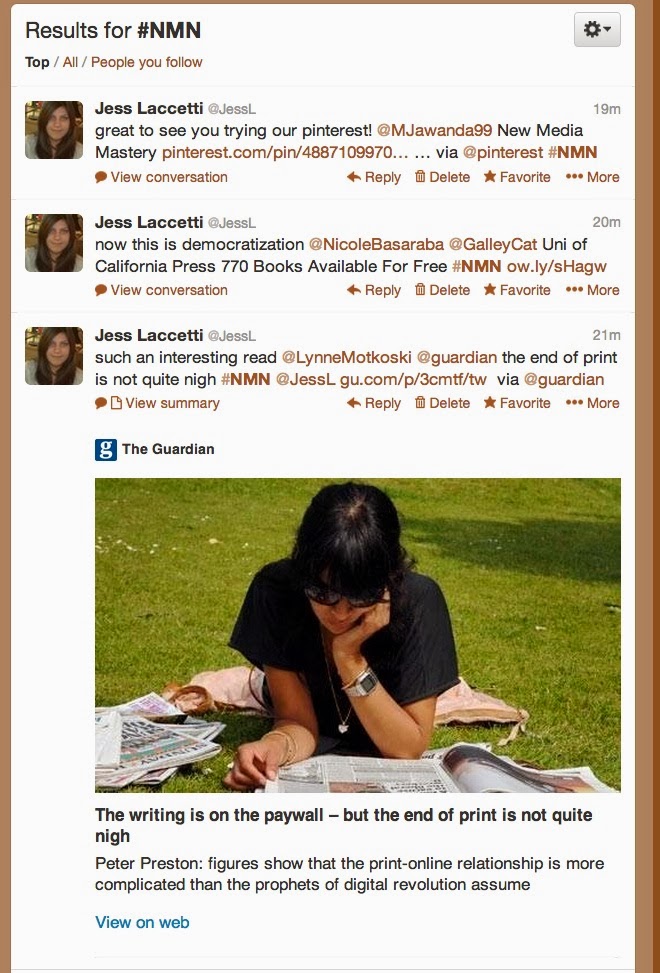
I've had several requests from students about how to follow fellow #NMN students on twitter. So, two things I'd like to ask:
- Consider adding your twitter alias in a comment to this post so that we all can see and then follow fellow students. We have quite a few interested readers who are not part of our class (welcome interested readers!)
- Remember to use the class hashtag, #NMN, when tweeting information pertinent to our class. I search for this tag, guest lecturers on our course will search for this tag and even previous students keep up to date with our developments by using this tag. It's a good way to keep our information organised.
Week 3: Digital Literature[s]
Week
3: Digital Literature[s]
|
Required
and Recommended Readings
|
This week we’ll have an overview of digital literature touching on the
early days of hypertext and pointing to born digital fictions.
Key Questions & Ideas:
★What is literature?
★Are blogs narratives?
★How is multimodal online narrative different from print narrative?
|
n “Electronic Literature
Seen from a Distance
The Beginnings of a Field,” Jill Walker Rettberg (http://www.dichtung-digital.org/2012/41/walker-rettberg/walker-rettberg.htm)
n Judy Malloy,
“Hypernarrative in the Age of the Web,” http://www.well.com/user/jmalloy/neapaper.html
Recommended:
Milana Knezevic, “Challenging mainstream narratives with social media,” (May
2013), (http://www.indexoncensorship.org/2013/05/kenya-social-media-muslimrage-twitter/)
|
Monday, 13 January 2014
Week 2: Print Culture & Publishing
To help put our readings in context, you might like to begin by listening to this podcast on the changing face of publishing.
Sunday, 12 January 2014
Week 2: Print Culture
|
Week 2: Making/Publishing
History: Printing of THE Book
|
Required and
Recommended Readings
|
|
Key Questions
& Ideas:
★The history of the book
★The end of books (!?)
★The net_reading/writing_condition
★What are some current views about the emergence and diffusion of media?
|
n “The Desktop Revolution,” Howard Brabyn, P. 16-19 (http://unesdoc.unesco.org/images/0007/000796/079609eo.pdf)
n Elizabeth Eisenstein, (1995). The End of the Book? Some Perspectives on
Media Change. American Scholar, 64541-555.
n “Pulp Fiction as Typography,” Jarratt Moody (Feb. 2007). (http://www.youtube.com/watch?v=wF8f8w6HPoo)
n Preston, Peter, “The
writing is on the paywall – but the end of print is not quite nigh,” The
Guardian (Dec. 2012). (http://www.theguardian.com/media/2012/dec/30/writing-on-paywall-end-of-print)
Recommended:
Clement, Richard W.
(1997). “Medieval and Renaissance Book Production,” Part II: The Printed Book.
P 13-18 (http://digitalcommons.usu.edu/cgi/viewcontent.cgi?article=1010&context=lib_pubs)
|
Subscribe to:
Posts (Atom)