Fellow student Nicole is working with me on a project about book trailers. Exciting right?!
Have you ever seen a book trailer?
Have a look below and PLEASE fill in our survey!!
We appreciate you sharing our survey across your networks.
Showing posts with label participation. Show all posts
Showing posts with label participation. Show all posts
Monday, 17 March 2014

Monday, 3 March 2014
Week 9: Transmedia Guest Lecture from Christy Deena
Here is the lecture from Dr. Christy Deena. Please read through and think about what Christy asks you to do. Leave your comments here, as usual, and Christy will respond towards the end of the week.
A
Quick Pulse Check on Transmedia
Transmedia storytelling is often understood
through a definition put forward by academic Henry Jenkins:
Transmedia
storytelling represents a process where integral elements of a fiction get
dispersed systematically across multiple delivery channels for the purpose of
creating a unified and coordinated entertainment experience. Ideally, each
medium makes it own unique contribution to the unfolding of the story. (source:
http://henryjenkins.org/2011/08/defining_transmedia_further_re.html)
Transmedia has kept evolving since the
early days of theories around its nature. Let’s have a look at some top-level
concepts that encompass key varieties of transmedia and see what we’ve learned
over the past ten years:
1. Medium
Story and experiences created with transmedia are
affected by the nature of the media involved. Just as one writes for the
affordances of film or television, writing a story that works across film and
the web needs skills not just with each medium involved, but across them too.
You have to create a storyworld (http://meanjin.com.au/blog/post/meanland-some-things-ive-learned-from-transmedia-worldbuilding/)
that works in different media (a concept borrowed from franchise development),
and you think about how your audience or players will be moved to continue with
the story across media and so on. Two types of medium dispersion have arisen to
various degrees however.
1.1 Intermedium
From the very beginning, most researchers and
practitioners championed the “multi-platform” nature of transmedia. Indeed, my
PhD thesis focused on creative works that are distinguished by their use of distinct media platforms (and
environments). These types of projects are an under-recognised form(s) that
deserved the spotlight transmedia theories provided. They’re not as pervasive
as other mono-medium works though, in no small part due to the diverse and open
thinking that transmedia requires. You don’t privilege or see artforms as
hierarchies in transmedia.
1.2 Intramedium
In practice though, what has emerged is a leaning towards intramedium
works. These sorts of works, where the experience is dispersed across “sites”
such as websites a kind of distributed narrative (http://jilltxt.net/txt/distributednarratives.html),
have become more accessible and welcoming to practitioners and audiences alike.
The creatives still need to work with the key creative challenge of transmedia:
that of creating a wholeness out of dispersed works. But they’re not dealing
with the added complication of medial boundaries. Lizzie Bennet Diaries (http://www.lizziebennet.com/)
is a recognised recent exemplar of this type of transmedia, one that I have
spoken about the significance of before (http://www.yousuckattransmedia.com/you-suck-at-seeing-transmedia-change/).
2. Production Timing
It is part of the community-defining rhetoric of digital
media to distinguish between “digital native” and “non-digital-native” works.
This language emerges because there is a natural tendency towards remediation (http://books.google.com.au/books/about/Remediation.html?id=kwZZdKiXG8wC&redir_esc=y)
. Indeed, anyone who works with “newcomers” finds that digital media is often
viewed first as a delivery channel (for example streaming TV rather than making
webisodes) and a place to adapt stories or games from another medium. It isn’t
viewed as an artistic medium in itself. The same happens with transmedia. Works
can be designed to be transmedia from the beginning, or made transmedia
retrospectively.
2.1 Proactive
Proactive transmedia encompasses those works that are
transmedia-native. They are designed to be transmedia from the beginning. Intramedium
transmedia are always proactive transmedia.
2.2 Retroactive
Retroactive transmedia explains works that become
transmedia because of the relationships added to an existing project. In most
cases the scenario operates as follows: a mono-medium project is created (eg: a
film or TV show or book or digital or analogue game); then either after it is
released or after it has at least been thoroughly developed, the world is
expanded in another medium. So the first work is designed to be experienced in
a single medium, and the next work then tries to change that nature. This can
be the harder route to take because the first work is conclusive, there isn’t
much else to explore. The lack of success in this type of approach accounts in
part for the lack of popularity with intermedium transmedia in some circles.
3. Reality aesthetics
A related phenomenon is “alternate reality aesthetics”. The
concept emerged with the rise of “alternate reality games” (http://en.wikipedia.org/wiki/Alternate_reality_game),
and is observable in many transmedia projects outside of ARGs. It involves a
relationship with the world of the player in some way. So rather than seeing a
medium as a conduit or window to another world one is transported to, the
actual present-time world is integrated in some way. This can be to various
degrees ranging from being completely set in the here and now observing all the
constraints of “reality” to involving fantastical elements too. A great majority
of proactive intramedium transmedia works have the world of the audience or
player recognised in some way.
4. Participatory
Likewise, another trait of transmedia is implemented to
varying degrees: that of the participatory nature. This involvement of the
audience or players can be participatory design (during the development and
production of the work), or participatory in the work. Like all of the
approaches described above, this affects the nature of the work and requires a
whole different skillset. It is perhaps the least pervasive approach though,
due in part to the difficulties the creative process entails rather than lack
of audience interest.
What
types of transmedia have you come across? Are there ones you prefer? If so,
why? Your answer might give an insight into the evolution of transmedia – why
it has developed in the direction it has, and where it might be going…
Week 9: Transmedia
Week
9: Transmedia
|
Required
and Recommended Readings
|
Guest Lecture by Christy Deena
|
n O'Flynn, S. (2012). Documentary's metamorphic form: Webdoc,
interactive, transmedia, participatory and beyond. Studies In
Documentary Film, 6(2), 141-157.
|
A bit about Christy Deena, our fantabulous guest-lecturer for this week.

Christy Dena is a writer-designer-director who has worked on award-winning pervasive games, film, digital and theatre projects. Clients include Nokia, Cisco/No Mimes Media, ABC, Wieden+Kennedy, Bangarra Dance Theatre, Noah Falstein, Ken Eklund & Agency of Coney, and many more.
Christy was granted Australia’s first Digital Writing Residency at The Cube for her project “Robot University,” funded by the Australia Council for the Arts and QUT. In 2012, she was the “Digital Writing Ambassador” for the Emerging Writers Festival; and a prototype of her project “AUTHENTIC IN ALL CAPS” was Finalist for “Best Writing in a Game” Award at the Freeplay Independent Gaming Festival. Christy co-wrote “The Writers Guide to Making a Digital Living” for the Australian Literature Board.
She has given keynotes and presentations at film, tech, writing, and gaming festivals worldwide, including Power to the Pixel (London), DIYDays (LA), TEDxTransmedia (Switzerland). She has mentored industry professionals around the world, including The Pixel Lab and Crossover; has written numerous articles on writing and design, and been published in numerous industry books. Christy was commissioned to run Transmedia Victoria, a key transmedia event in Melbourne bringing professionals from TV, film, performance, art, and gaming together.
She is Professor Adjunct at Creative Industries, QUT; Game Design Lecturer at SAE Brisbane; a Member of the International Academy of Television Arts and Sciences (Emmys); and a Board Member of the Entertainment Technology Press (ETC).
Christy has been a juror for the International Digital Emmy Awards, IPF Web Drama Series, and many other programs including the Australia Council for the Arts. She wrote the first PhD on Transmedia Practice, and wrote the definition of ‘transmedial fictions’ for the forthcoming The Johns Hopkins Encyclopedia of Digital Textuality. Christy has released her award-nominated web audio adventure for the iPad called AUTHENTIC IN ALL CAPS (with the crowdfunding campaign being the biggest successful campaign for a game on Pozible to date). Her digital installation “Robot University” was launched at The Cube, QUT; and her playful story for the phone, “Guardians of Hidden Universes” was released at the first outdoor pervasive gaming festival: Popup Playground’s Fresh Air Festival.
Sunday, 19 January 2014
#NMN Students and Twitter
One way you all might want to keep abreast with fellow students tweeting about #NMN news, is to follow my list.
I've made a list on Twitter of all the students who have shared with me their Twitter aliases. If you haven't please do (or post it in the comment on the Twitter post earlier today). I will add you to the list and if you follow the list, you will see all the tweets.
Here is how the list looks now:
Tweets from https://twitter.com/JessL/nmn-2014-students
I've made a list on Twitter of all the students who have shared with me their Twitter aliases. If you haven't please do (or post it in the comment on the Twitter post earlier today). I will add you to the list and if you follow the list, you will see all the tweets.
Here is how the list looks now:
Tweets from https://twitter.com/JessL/nmn-2014-students
If you are a student in our #NMN 2014 running, please consider adding your Pinterest board (well, a link to it) and/or a link to your Pinterest profile in the comments' section of this post. We can all keep up with each other and our pins.
Of course, you can also e-mail me your Pinterest information which I'll keep track of for your web 2.0 participation mark.

Of course, you can also e-mail me your Pinterest information which I'll keep track of for your web 2.0 participation mark.
#NMN and Twitter
Firstly, thank you all (well, almost all of you...) for participating online! You are practising new tools, perfecting your craft and refining your transliteracy skills. Additionally, by participating online, you are furnishing your online profile.
I've had several requests from students about how to follow fellow #NMN students on twitter. So, two things I'd like to ask:
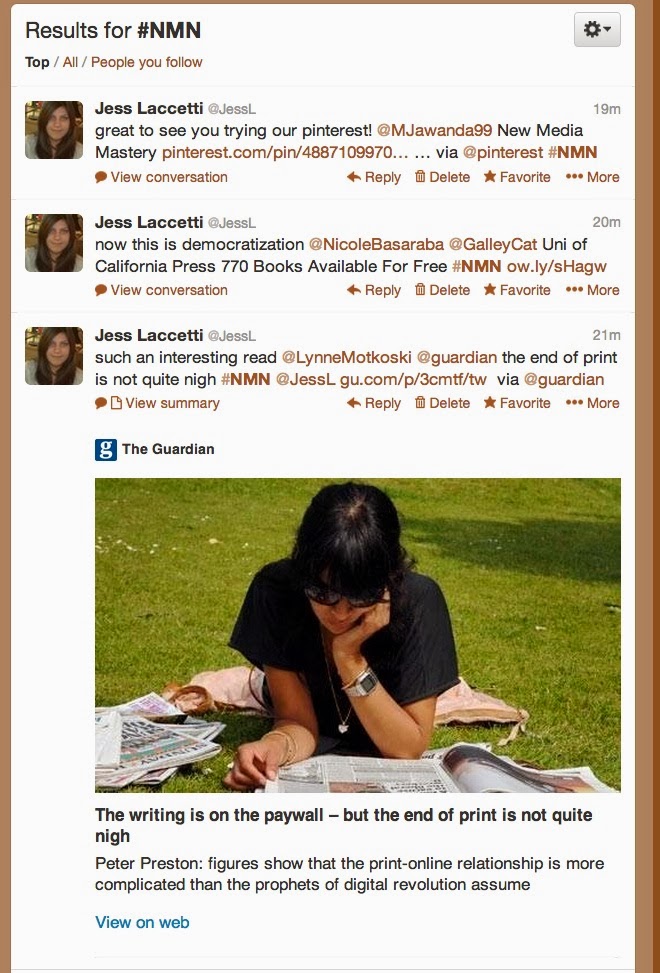
I've had several requests from students about how to follow fellow #NMN students on twitter. So, two things I'd like to ask:
- Consider adding your twitter alias in a comment to this post so that we all can see and then follow fellow students. We have quite a few interested readers who are not part of our class (welcome interested readers!)
- Remember to use the class hashtag, #NMN, when tweeting information pertinent to our class. I search for this tag, guest lecturers on our course will search for this tag and even previous students keep up to date with our developments by using this tag. It's a good way to keep our information organised.
Subscribe to:
Posts (Atom)