Showing posts with label #NMN. Show all posts

Friday, 4 April 2014

Assignment #3 - eRevolution

When publishing changes, so does society. And nothing changed society more profoundly than the printing press. The invention of the printing press created a media revolution in the 1400’s. The technology behind moveable type led to mass production of books throughout Europe. It has only been until very recently that publishing has drastically changed and again society is changing with it.

This sound documentary will examine the impact of digital media and digital publishing on government agencies today and the effect it has on our country’s citizens.

For this sound piece I used Camtasia Studio to record the Internet sound clips included in this recording. I used the memo audio recording feature on my iphone to record my voice and I put all the audio clips together using Audacity.

The printer sound effect and the music at the conclusion of this sound file were taken from the Nova Scotia Queen's Printer Web site.


Resources:
E-Government Canada - 2005. Retrieved from http://www.youtube.com/watch?v=HMv9KKUaU9w

Fry, S. (2013). Stephen Fry & The Machine That Made Us. Retrieved from http://www.youtube.com/watch?v=TiamVHT2Hz4
Gordon-Murnane, L. (2002). Digital government: digital tools for the electronic dissemination of government information. Searcher, 10(2), 44-53 Mayer Schonberger, V.(2011).  How have advances in information technology transformed government? Retrieved from http://www.youtube.com/watch?v=NJ-JyDO0vHs
Nova Scotia Queen's Printer Web Site http://novascotia.ca/cns/queens-printer.asp

Wikipedia. Printing Press. Information retrieved from http://en.wikipedia.org/wiki/Printing_press

Assignment #3: The Interaction Between Digital Network Media, Publishing, & Society


By Jonathan Krywulak

 
The emergence of digital network media has transformed the 21st century society and its relationship with publishing institutions.   The expression and perception of social identities has been shaped by new forms of technology that spans cultural spheres and geographical boundaries allowing communication from many to many.  The increased speed, convenience and interactivity of new media have blurred the distinction between consumers and producers, providing people with the ability to be in control of their own media world.


References:

Benkler, Y. (2006). The wealth of networks: How social production transforms markets and
freedom. Yale University Press.
 
Tubella, I. (2004). Television and internet in the construction of identity. The Network Society: A
Cross-Cultural Perspective. Cheltenham, UK & Northampton, MA: Edgard Elgar
Publishing Limited
 
Audio Clip #1:  Windows sounds mix by DJ Titon. Retrieved from http://youtu.be/cewQJFTolO0

Audio Clip #2:  Shirky, C. (2009) How social media can make history. Retrieved from https://www.ted.com/talks/clay_shirky_how_cellphones_twitter_facebook_can_make_history

Audio Clip #3: Lessig, L. Crash course in the "read-write" internet. Retrieved from http://www.youtube.com/watch?v=7nBL8eClYuU

Audio Clip #4: Lessig, L. Creativity.  Retrieved from http://www.youtube.com/watch?v=NGWQVxrRXyU

Assignment #3: Old and New Media Power Struggle


We explore, through 2 interviews with Dr Henry Jenkins, how digital network media has shifted the power from traditional publishing institutions to society. News is no longer delivered only by newspapers. Rather, because of the internet, we are in a convergence culture where new media users participate and collaborate in creating news, or spreadable media, that moves from grass roots communication through out society.


Burnett, L. (2013, March 10). #SXLB: Henry Jenkins, Media Theorist, Author & Professor, Pt. 1: Grassroots. Retrieved April 3, 2014, from You Tube.

Dixon, A. (2012, 21). A Word From Henry Jenkins on Convergence. (Students Demonstrating Example of User Generated content) Retrieved April 3, 2014, from You Tube.

Edmonds, R.G. (2013, May 7). Newspapers: by the Numbers. Retrieved April 3, 2014, from The Pew Research Center's Project for Excellence in Journalism: 

Laird, S. (2012, April 18). How Social Media Is Taking Over the News Industry [INFOGRAPHIC]. Retrieved April 3, 2014, from Mashable 

Sondeen, A.L. (2009). Building Blocks for Change Increasing Newspaper Readership in the Age of Electronic Media throu Innovations in Style and Approach. Senior Honors Theses, Easter Michigan University, DigitalCommons@EMU. Retrieved April 3, 2014, from  http://commons.emich.edu/cgi/viewcontent.cgi?article=1192&context=honors

Assignment #3 - Defending remix culture? Art history can help

By Andrea Soler

This visual essay will show how remix – in the sense of appropriation – has been present in art history for centuries. Through a combination of digitally-collaged images and quotes about remix, this series of images addresses the question: Is the remix culture fundamentally at odds with older media institutions and practices?

 The challenge of producing 20 images, instead of curating existing images, makes Gilberto Gil’s quote “Nobody creates in a vacuum” in RIP: A Remix Manifesto truly comprehensible. Taking, using and modifying existing content is now ingrained in our digital culture. Creating new content, even if it is a collage of existing one, could be daunting. However, this visual essay will illustrate how remix existed long before the advent digital media.

Flickr link to photo set:
https://www.flickr.com/photos/78193356@N07/sets/72157643387323723/

1. The following images will show how the act of remixing in the sense of appropriating to create something different has been around for centuries. These series of images mainly focus in the visual arts, while touching on fashion, music, technology and TV.


2. The remix is “a conscious process used to innovate and create. In fact, it’s no exaggeration to say that the cut-‘n’-paste culture born out of sampling and remixing has revolutionized the way we interpret the world” (Mason, 2008, p. 71).


3. The word “remix” is no longer about music alone, it is a fluid movement that captures how society participates and creates. According to Guertin (2012) “reflexive remixing creates a unique and original work from pre-existing parts” (p. 120).
Girl Talk photo by Moses Namkung CC / Chef John Horne by photo by Renée Suen CC


 4. If “Remixing is about taking something that already exists and redefining it in your own personal creative space, reinterpreting someone else’s work your way” (Mason, 2008, p. 71), then remixing is present throughout history.
Food truck client: My father / Cropped gallery photo by Kyoss Magazin


 5. The history of art is full of examples of how remixing existed long before the digital era. Most art movements know as “isms” like Realism, Impressionism, pointillism and Modernism are reactions and reinterpretations of previous artistic movements.


 6. ...Impressionism was once controversial.


 7. Creative expressions and avant-garde movements as Cubism have been met with opposition before being accepted. With the benefit of time we begin to understand the context of why these artistic changes happened, what triggered them and most importantly what they set in motion.


 8. In 1913 Duchamp created the first ready-made by mounting a bicycle wheel on a stool, followed by the “Urinal” a few years later. Much like the remix, “ready-mades illustrate the proposition that the work of an artist consists essentially of the assembling of pre-existing materials” (Britt, 1989, p. 306).


 9. After Duchamp everything was possible, including movements like pop art, which in the sixties appropriated popular images of mass culture and transferred them to the art world. Warhol is a good example.


10. Even controversial artist Damien Hirst and his famous formaldehyde shark, used Duchamp’s conceptual remix (appropriation) of existing materials/works as a foundation for his work. A few years earlier Jeff Koons had a similar approach with his “Three Ball 50/50 Tank.” Shark photo by Gazanfarulla Khan C


11. In contemporary art almost everything is product of “spheres of influence across centuries of art history”(Guetin, 2012, p. 121). Contemporary art often refers to existing artwork to create a statement that is relevant to our time or to question previous beliefs. A creative spiral.


12. In a similar way that pop art appropriated images from mass culture and TV and brought them to the art world, so too we have seen how TV and movies have taken ideas and stories from books and comics.


13. This applies to arts, literature, music, theater, movies, TV and even fashion and media technology.


14. According to Mason (2008) fashion illustrates how encouraging remixing, copying, and reinventing can trigger creativity and innovation. “Without any intellectual property protection, a ferocious multibillion-dollar industry thrives and survives because designers share ideas and are free to remix the works of others (p. 96)


15. Says Gilberto Gil, Brazil’s former Minister of Culture during the RIP: A remix manifesto (2008).


16. Media technology is not an exception to this remix culture. In “Everything is a Remix – Case Study of the iPhone” (2014) Ferguson illustrates how despite iPhone’s innovation many of its initial functions purposely resembled other technologies (keyboard sounded like a typewriter, iBooks displayed on virtual shelves).


17. Ferguson (2014) says that as people got used to smartphone technology, Google’s Android operating system evolved Apple’s iPhone ideas moving away from resembling older technologies. In turn iPhones evolved Android’s ideas. According to Ferguson everything is remix.


18. Beyond technology’s fight for market share, remixing is about creating and participating for the joy of it. Guertin states “it is the experience of the act of sharing creation – the process of circulating – that has become the aesthetic of production for the multitude in a digital age”(2012, p. 124).


19. Creative Commons licenses are an option for creative people who like sharing their work and allowing others to make something different out of it. These licenses are meant to work alongside traditional copyright laws. Wonder what Warhol would have thought about it?


20. Can we say that the remix culture is fundamentally at odds with older media institutions and practices, when we have witnessed the presence of remix in centuries of art history and culture? Quoting Jean Luc Godard, Guertin (2012) highlights the essence of remix: it is were it takes us, its creative potential. Godard photo by Garry Stevens CC


References: Britt, D. (Ed.). (1989). Modern art: Impressionism to Post-Modernism. Spain: Bulfinch Press.

Ferguson, K. (2014). Everything is a remix – Case study of the iPhone [Video]. Retrieved from http://everythingisaremix.info/blog/everything-is-a-remix-case-study-the-iphone

Gaylor, B. (Director/Writer), EyeSteelFilm & National Film Board of Canada (Co-Producers). (2008). RIP: A remix manifesto. (Documentary). Canada.

Guertin, C. (2012). Digital prohibition: Piracy and authorship in new media art. New York, NY: Continuum International Pub.

Mason, M. (2008). The pirate’s dilemma: How youth culture is reinventing capitalism. New York, NY: Free Press.

Flickr link to photo set
https://www.flickr.com/photos/78193356@N07/sets/72157643387323723/


Monday, 31 March 2014

Diana Brown's Assignment #3 - Paper vs. Pixels: Printed Books and eReaders in Education

When publishing changes, so does society. Investigate and compare the impact of two publication technologies, one pre-1900 and one post-1962, on a specific aspect of society (e.g. education, politics, creative industries, science, entertainment, social relationships). 

The publishing technologies that I chose to compare were printed books versus electronic books (available on various eReaders). Newton’s Third Law of Motion is relevant to this topic because “for every action there is an equal and opposite reaction”. It seems as though for every upside to traditional publishing and printed books, there is a downside to ePublishing and eBooks. It also works the other way around - for every eBook pro there is strike against printed books.

Although society often focuses on the shortcomings of each medium, we need to stop treating these two resources as opposing forces, as each serves unique purposes. These publishing platforms can work together and make up for each others deficiencies to provide timely, relevant and authentic information for use in educational settings.

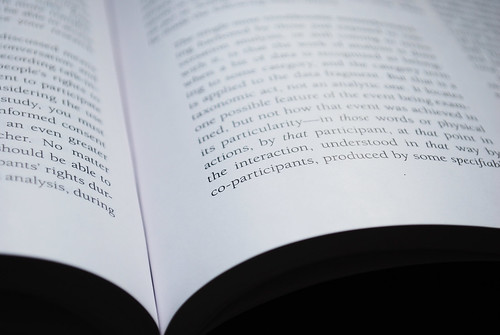
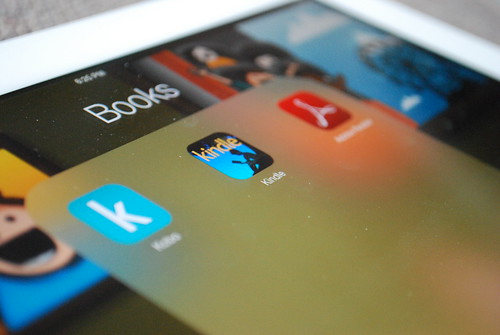
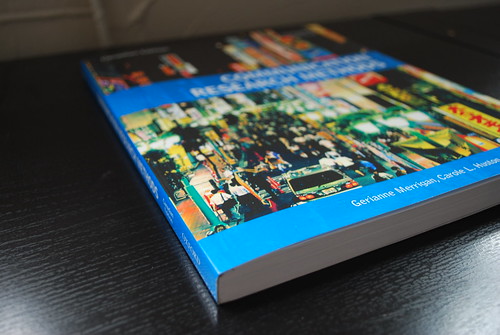
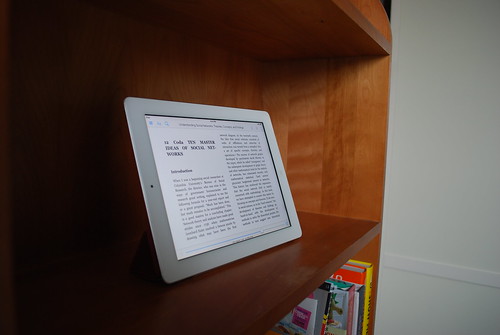
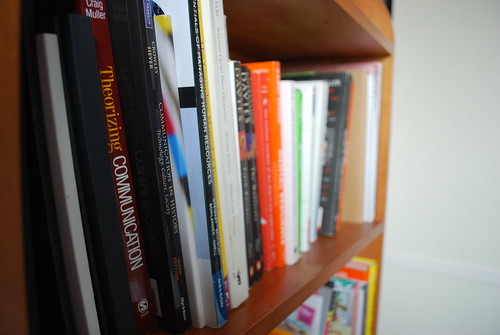
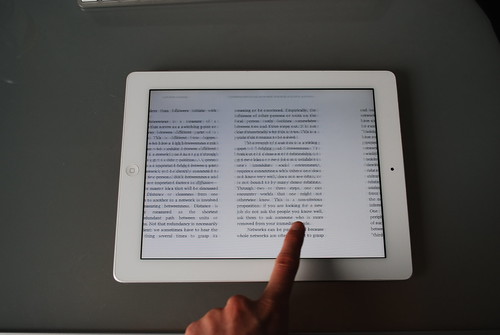
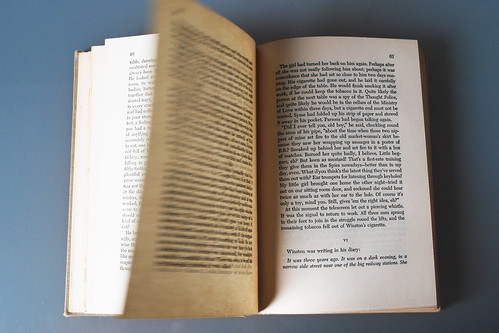
In my Flickr photo collection, I have juxtaposed printed books and eBooks to show how one’s weakness is the other’s strength. My goal in this collection is to show how each medium balances the other (… the yin and yang of publishing!). Here is how each format reigns supreme in various categories of importance to readers in educational settings:


Book
eBook
Authenticity
✯


Longevity
✯


Readability
✯


Simplicity
✯


Reliance
✯


Searchability


✯
Portability


✯
User Experience


✯
Accessibility


✯
Currency


✯

Please click here to see my set of 20 images on Flickr that capture the reasons why these two publishing platforms work so well together in the realm of education.


AUTHENTICITY

Authenticity - Book (Pro)
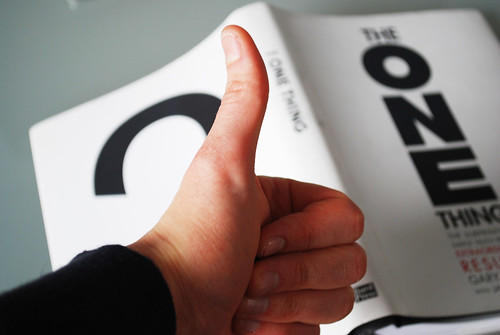
Book (Pro) - The physical book wins out over eBooks when it comes to authenticity. Printed books are generally seen as more credible because of the traditional publishing process (one-to-many model). This process ensures that the written work is vetted by many individuals (including literary agents, editors and retailers, among others). This helps “weed out’” inaccurate and low-quality work for use in educational settings.

Authenticity - eBook (Con)
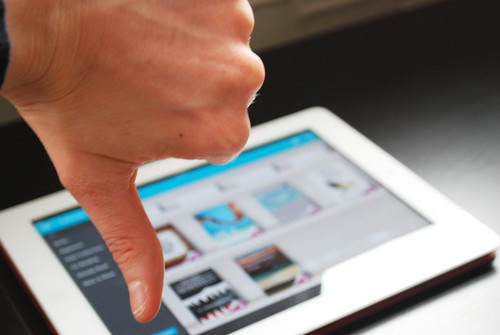
eBook (Con) - eBooks can’t compare to physical books when it comes to authenticity. eBooks are simple to create and the process is becoming more streamlined all the time. Because of the ease of creation, anyone with a computer and an Internet connection can publish an eBook (many-to-many publishing model). When everyone is a publisher, who is responsible for filtering out the noise? Teachers? Students? This is still a grey area.


LONGEVITY

Longevity - Book (Pro)
Book (Pro) - The physical book wins out over eBooks when it comes to longevity. Printed works can last hundreds of years if properly preserved and even many decades if improperly preserved. Printed books can be used in the classroom and they will continue to exist in their physical form, with the exception that they are physically destroyed. You can spill a drink on them, remove parts and roll them up without doing damage to the overall product. When was the last time you said the same thing about an eReader?

Longevity - eBook (Con)
eBook (Con) - eBooks can’t compare to physical books when it comes to longevity. Sure, there is little fear that “ripping out pages” will damage a file, however one or two wrong clicks will result in a losing the entire work. The high cost of digital textbooks, paired with this sense of impermanence leaves consumers feeling uneasy about buying expensive ePublications. Additionally, purchasing eBooks are commonly thought of as “renting” not “buying” because files reside on server. This lack of control has some readers running for the hills!


READABILITY

Readability - Book (Pro)
Book (Pro) - The physical book wins out over eBooks when it comes to readability. Ink on paper provides high contrast and makes it easy to read the printed page. Off-white and cream-coloured stocks are typically preferred by long document publishers because they are easy on the eyes.

Readability - eBook (Con)
eBook (Con) - eBooks can’t compare to physical books when it comes to readability. Screen fatigue makes reading pixels on a screen tiring on the eyes. Many eReaders use e-ink technology to mimic ink on paper, but the simulation is never as good as the real thing.


SIMPLICITY

Simplicity - Book (Pro)
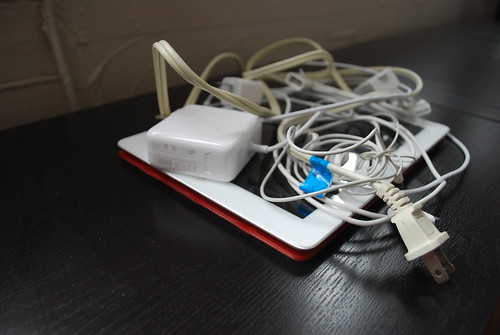
Book (Pro) - The physical book wins out over eBooks when it comes to simplicity. Books are intuitive to use and navigate - simply open up a book and begin reading. There are no wires or cords or electrical plugs to worry about. Ink on paper is as simple as it gets.

Simplicity - eBook (Con)
eBook (Con) - eBooks can’t compare to physical books when it comes to simplicity. File type confusion and incompatibility (.epub as the standard format vs. the .mobi Amazon Kindle-specific format) can make buying, downloading and reading a book challenging. The un-tech savvy reader may have difficulty understanding which format is needed for which device and it just isn’t the same as picking up a printed book.


RELIANCE

Reliance - Book (Pro)
Book (Pro) - The physical book wins out over eBooks when it comes to reliance. Books are stand-alone products that don’t need additional tools. Printed books do not rely on external power sources or high-tech gadgetry to be consumed. An eReader with low battery isn’t very useful during a power outage.

Reliance - eBook (Con)
eBook (Con) - eBooks can’t compare to physical books when it comes to reliance. eReaders require external power for recharging, as well as software support post-purchase. Because of this reliance on external power, eReaders are of little use in remote areas or situations where there is limited access to power (ex: studying for an exam on a transatlantic flight).

SEARCHABILITY

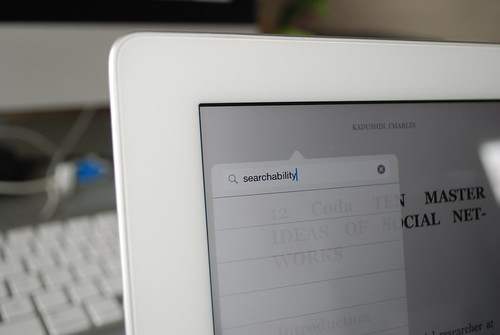
Searchability - eBook (Pro)
eBook (Pro) - eBooks win out over physical books when it comes to searchability. There is a search function within every eReading platform, which enables users to quickly and easily search for keywords throughout the document. Furthermore, hyperlinking increases the reach of standard search functionality by directing users to further information on the World Wide Web.

Searchability - Book (Con)
Book (Con) - Physical books can’t compare to eBooks when it comes to searchability. It takes time to find a specific passage or topic in a book, as the reader must look up keywords in the index or flip through book to find what they are looking for. The static nature of books makes them inherently difficult to search, which can be incredibly frustrating, especially for a student conducting research.


PORTABILITY

Portability - eBook (Pro)
eBook (Pro) - eBooks win out over physical books when it comes to portability. Students can carry a library’s worth of books on a very small device, which can be incredibly helpful for students who travel often. Whether commuting a short distance to school or travelling much further, eReaders are compact, lightweight and inherently portable.

Portability - Book (Con)
Book (Con) - Physical books can’t compare to eBooks when it comes to portability. It is logistically difficult to move multiple textbooks around. Paper is heavy and it is not easily transportable across campus or across the country. Multiple bags may be necessary to lug required books from one place to another (not to mention overweight baggage fees at the airport!).


USER EXPERIENCE

User Experience - eBook (Pro)
eBook (Pro) - eBooks win out over physical books when it comes to user experience. Online collaboration tools built into eReading devices connect one solitary reader to another directly on the reading platform. This facilitation of connecting like-minded readers with one another fosters a community of learners who don’t feel like they are tackling the material alone (even if they are at different schools in different cities or even different parts of the world). Furthermore, social networking capabilities within eReading platforms (ex: Kobo’s Reading Life) promote conversation and lifelong learning within an online community.


User Experience - Book (Con)
Book (Con) - Physical books can’t compare to eBooks when it comes to user experience. Reading a book is a solitary experience and only one person can read a single book (comfortably) at one time. Students may feel a sense of isolation in the material they are studying because it is near to impossible to interact with other users through the platform of a physical book.


ACCESSIBILITY

Accessibility - eBook (Pro)

eBook (Pro) - eBooks win out over physical books when it comes to accessibility. Readers can choose their preferred typeface, font size and colour contrast level to suit their accessibility needs. Furthermore, audiobooks and read-aloud capabilities are more commonly available within the newer .epub files.

Accessibility - Book (Con)
Book (Con) - Physical books can’t compare to eBooks when it comes to accessibility. Small type, as well as low contrast or faded text can make a book difficult to read for someone with even a minor visual impairment. Although large-print options do exist, they are seldom available for textbooks.


CURRENCY

Currency - eBook (Pro)

eBook (Pro) - eBooks win out over physical books when it comes to currency. The nature of ePublications makes it so that there is a much faster time to market, as publishers do not have to wait for the books to be manufactured and distributed (which can take weeks). Furthermore, the ability to update an .epub file is much simpler and therefore has a faster time to market than traditional ink on paper products.

Currency - Book (Con)
Book (Con) - Physical books can’t compare to eBooks when it comes to currency. Time to market is much slower in a traditional publishing process; therefore the reader is not always reading the most current information. Updated editions of printed books do become available, but they are typically updated every few years. This can be especially critical for hi-tech fields, where the rate of technological change makes buying a textbook impractical when the information may change in a few months.

Sunday, 30 March 2014

Jonathan Krywulak’s Storify: Transliteracy / Transmedia

COMM 597: New Media Narratives Course #NMN provided an explorative journey through the concepts of Transliteracy and Transmedia.   Through a mixture of articles, videos, blogs, tweets, images, and comments we were better able to grasp what it means to be Transliterate and the value associated with it.  My Storify provides a brief overview of Transliteracy and its relation to Transmedia Narratives, where people have the ability to create, curette, and consume content.


#NMN - #Transliteracy and #Digital Literacy